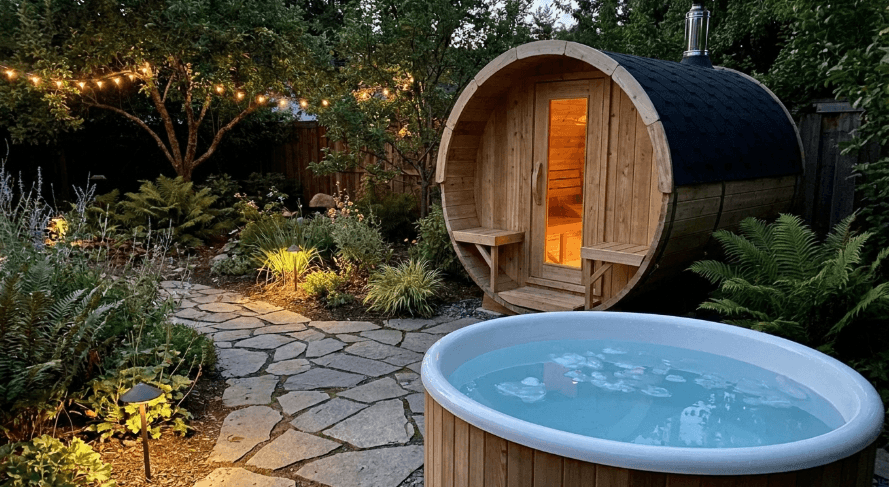
The right sauna size for daily use is the smallest one that comfortably fits the people who will actually use it, because a correctly sized cabin heats faster, costs less to run per session, and is more likely to get used every day than an oversized room that takes forty minutes to warm up. For one or two people, that generally means a cabin in the 60 to 90 cubic foot range, roughly 4 by 5 feet of floor space. The evidence on sauna benefits tracks with frequency and duration of use, not square footage, which makes right-sizing a practical decision rather than a compromise.
Why Does Room Size Affect Whether You Actually Use It Daily?
The biggest threat to a daily sauna habit is friction, and warm-up time is the single biggest source of it. A properly sized small cabin with a matched heater reaches 150 to 195 degrees in roughly 20 to 30 minutes. An oversized room with the same heater, or a correctly sized heater in a room that is bigger than it needs to be, can take 45 minutes or longer, which is often the difference between a habit that survives a busy Tuesday and one that gets skipped. The evidence supporting sauna use as a health habit is built on people who used one consistently, several times a week over years, not people who owned one but rarely got in it because the warm-up ate their whole evening.
How Much Space Does One or Two People Actually Need?
A single user is comfortable in a cabin as small as 3 by 4 feet, though most buyers choose slightly larger for the ability to lie down or stretch out, which some research on sauna sessions associates with longer, more relaxed session duration. Two people generally need a cabin closer to 4 by 5 feet, giving each person bench space without crowding. Beyond two regular users, the math changes fast, a four-person cabin needs roughly double the interior volume, a proportionally larger heater, and meaningfully more electricity per session, all for capacity that a household of one or two rarely uses to its full extent on a given day. It is worth being honest about who will actually use the cabin on a typical Tuesday rather than sizing for the occasional gathering, since a room built for four that mostly sees one daily user just adds warm-up time and running cost without adding value most days of the week.
Bench layout affects how efficiently a small footprint gets used just as much as raw square footage does. A single-tier bench running the length of one wall wastes less interior volume than two parallel benches facing each other, since the second bench eats into the room’s usable heat zone without adding real seating value for one or two daily users. An L-shaped bench along two walls is often the better compromise, giving a second person a seat without pushing the cabin’s overall footprint, and therefore its heater size, any larger than necessary.
How Do You Actually Calculate Heater Size for a Given Room?
Multiply the room’s length, width, and height in feet to get cubic footage. A cabin measuring 4 by 5 feet with a 7-foot ceiling comes out to 140 cubic feet. Divide that by roughly 45 to 60, the commonly used range for a well-insulated space, to land on an estimated kilowatt requirement, in this case somewhere around 2.3 to 3.1 kilowatts as a baseline, adjusted upward for a glass door, a large window, or an uninsulated exterior wall, any of which pulls heat out faster than solid insulated panels. Manufacturers publish sizing charts specific to their heater lines and should be consulted directly, since stated kilowatt output varies by brand even at similar physical heater size. Ceiling height deserves a second look in this calculation, since a room with an 8-foot ceiling instead of a 7-foot one adds meaningful cubic footage without adding any usable floor space, pushing heater requirements up for no real gain in comfort or seating.
Does Sizing Correctly Change Long-Term Running Cost?
Yes, and the difference compounds daily. A right-sized 3 kilowatt heater running a 25-minute warm-up costs meaningfully less per session than an oversized 6 kilowatt heater working to fill a room twice the necessary volume for the same two users. Over a year of daily use, that difference in electrical draw adds up to real money, often the gap between a sauna that feels affordable to run every day and one that quietly becomes a once-a-week indulgence because of the utility bill. Comparing interior cubic footage against stated heater kilowatts across models, including the options in the SweatDecks saunas collection, is the fastest way to spot a size mismatch before ordering rather than after the first month of bills.
What Does the Research Actually Say About Session Frequency and Size?
The studies most often cited in sauna marketing were not measuring room size at all, they were measuring how often and how long people used whatever sauna they had access to. A 2018 review in Mayo Clinic Proceedings summarized cardiovascular associations tied to session frequency across multiple studies, with the strongest associations linked to men using a sauna four to seven times a week. A separate systematic review in Evidence-Based Complementary and Alternative Medicine reached similar conclusions about regular use. A 2023 Mayo Clinic Proceedings review looking at sauna bathing alongside other lifestyle factors again measured frequency and duration, not cabin dimensions. A small, right-sized cabin used daily fits the use pattern this research actually describes far better than a large cabin used occasionally because it takes too long to heat up on a weeknight. These remain associations from mostly Finnish cohorts, not proof of causation for any individual.
Frequently Asked Questions
What size sauna is best for one or two people using it daily? A cabin around 4 by 5 feet with 60 to 90 cubic feet of interior volume fits one or two people comfortably and heats efficiently for daily use.
Does a bigger sauna mean a better session? Not for daily use by one or two people. A larger room needs a bigger heater, takes longer to heat, and costs more per session without improving the session itself.
How do you calculate the right heater size for a room? Multiply length, width, and height in feet for cubic footage, then divide by roughly 45 to 60 for an estimated kilowatt requirement, adjusting for glass or uninsulated walls.
Is a small sauna enough to get the studied health benefits? Yes. The research tracks session frequency and duration, not room size, so a well-sized small cabin used regularly fits the same pattern the studies describe.
References
- Cardiovascular and Other Health Benefits of Sauna Bathing: A Review of the Evidence, Mayo Clinic Proceedings, 2018
- Clinical Effects of Regular Dry Sauna Bathing: A Systematic Review, Evidence-Based Complementary and Alternative Medicine, 2018
- Does the Combination of Finnish Sauna Bathing and Other Lifestyle Factors Confer Additional Health Benefits? A Review of the Evidence, Mayo Clinic Proceedings, 2023